
How Do Bearing Clearance and Lubrication Affect High-Speed Performance?
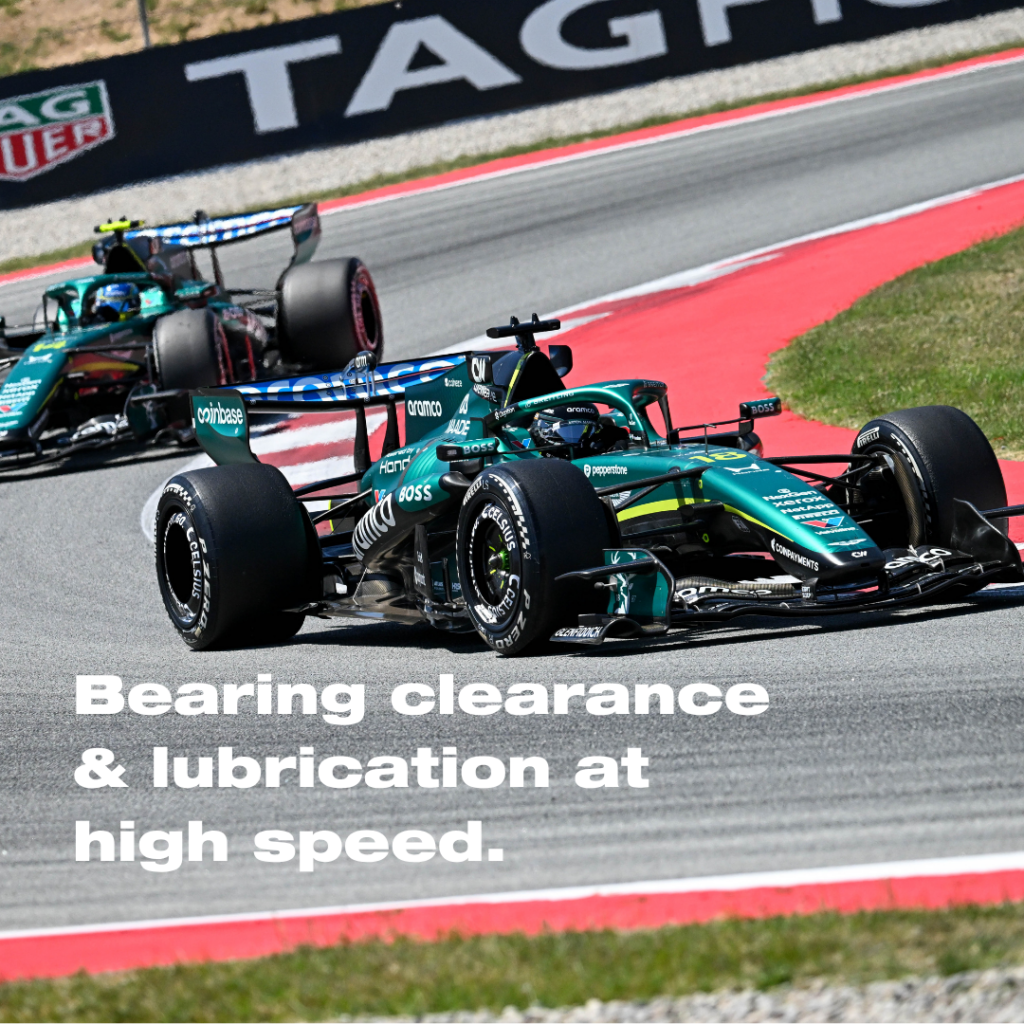
Understanding bearing clearance and lubrication.
A bearing can be the correct size, type and material but still perform badly at high speed.
The problem may not be the bearing itself. It may be the clearance left inside it or the lubricant placed around it.
Bearing clearance controls how the rolling elements move between the inner and outer rings. Lubrication creates a protective film between the contact surfaces.
At high speed, both are affected by temperature, mounting fits and centrifugal forces.
If clearance becomes too small, the bearing may generate excessive heat. If it is too large, the assembly may lose stiffness and accuracy.
Too much lubricant can also generate heat. Too little can allow damaging metal-to-metal contact.
High-speed bearing performance is therefore a balancing act. More clearance is not automatically better. Neither is adding another enthusiastic handful of grease.
In 30 Seconds
Bearing clearance is the internal movement between the rolling elements and raceways.
The clearance measured before installation is not necessarily the clearance available during operation.
Mounting fits, preload and temperature can all reduce it.
Lubrication separates the bearing’s contact surfaces. It also reduces wear, controls friction and can help remove heat.
At high speed:
- Too little clearance may increase friction and temperature.
- Too much clearance may reduce stiffness and running accuracy.
- Too much grease may cause churning and heat.
- Too little lubricant may cause wear, smearing or seizure.
- Incorrect viscosity may create drag or inadequate film thickness.
- Contamination can damage precision rolling surfaces.
The correct solution depends on the complete application.
Key Takeaways
- Initial and operating bearing clearance are not the same.
- Tight shaft and housing fits can reduce internal clearance.
- Temperature differences between bearing rings also change clearance.
- C3 clearance is greater than normal clearance, not a quality grade.
- Preload improves stiffness but can increase heat if excessive.
- Lubricant must form a protective film at operating temperature.
- High lubricant viscosity can create drag and heat.
- Low viscosity may provide insufficient surface protection.
- More grease is not automatically safer.
- Clean application and controlled lubricant quantities matter at high speed.
What Is Bearing Internal Clearance?
Bearing internal clearance describes the free space that allows the rolling elements to move within the inner and outer rings.
This movement may be measured in two directions:
- Radial clearance: Movement across the bearing
- Axial clearance: Movement along the bearing’s axis
However, there are several stages of clearance to consider.
| Clearance Stage | What Does It Mean? |
|---|---|
|
Initial’s clearance |
Clearance inside the bearing before installation |
|
Mounted clearance |
Clearance after the bearing is fitted to the shaft and housing |
|
Operating clearance |
Clearance while the bearing is running at its normal load and temperature |
|
Preload |
A controlled internal load that removes clearance |
NTN’s technical guidance on bearing clearance explains that operating clearance is usually smaller than the initial clearance. Mounting fits and temperature differences between the bearing rings both contribute to this reduction.
The number printed on the bearing box only describes the starting point.
What matters is the clearance left when the bearing is installed, hot and rotating.
Why Does High Speed Make Clearance More Important?
As bearing speed rises, friction and lubricant movement generate heat.
Heat changes the dimensions of the:
- Inner ring
- Outer ring
- Shaft
- Housing
- Rolling elements
These parts may not reach the same temperature. They may also use materials with different thermal expansion rates.
The inner ring often runs hotter than the outer ring. If it expands more, internal clearance can reduce.
Centrifugal forces may also affect the rolling elements, cage and rotating rings.
A small error that causes little trouble at low speed can become much more serious as temperature and speed increase.
This can create a feedback loop:
- Clearance becomes too small.
- Friction increases.
- The bearing generates more heat.
- Thermal expansion reduces the clearance further.
- Friction and temperature continue to rise.
Stopping this process before it damages the bearing is considerably easier than explaining the resulting collection of blue metal parts.
What Do CN, C2 and C3 Bearing Clearances Mean?
Bearing clearance is commonly grouped into standard classes.
| Table Header | Table Header |
|---|---|
|
C2 |
Less Clearance Than Normal |
|
CN |
Normal Internal Clearance |
|
C3 |
Greater clearance than normal |
|
C4 |
Greater Clearance than C3 |
|
C5 |
Greater clearance than C4 |
The actual clearance range depends on the bearing type and size.
C3 does not mean “higher quality”. It does not automatically mean “high speed” either.
It simply means the bearing has more initial internal clearance than a comparable CN bearing.
A C3 bearing may be selected when engineers expect mounting fits or temperature differences to remove more clearance during operation.
However, if the application does not reduce that additional clearance, the bearing may run with too much movement.
The clearance class must match the operating conditions.
Does a High-Speed Bearing Always Need C3 Clearance?
No.
Higher speed can increase temperature, which may support the use of greater initial clearance. However, speed is only one factor.
Engineers must also consider:
- Shaft fit.
- Housing fit.
- Inner-ring temperature.
- Outer-ring temperature.
- Bearing size.
- Bearing type.
- Shaft material.
- Housing material.
- Load.
- Required stiffness.
- Cooling.
A high-speed bearing with light fits and effective cooling may not require C3 clearance.
A slower bearing with heavy interference fits or a large temperature difference might.
Choosing C3 because it sounds more technical is not an engineering calculation.
How Do Mounting Fits Change Bearing Clearance?
A bearing must normally be fitted tightly enough to prevent its rings from moving against the shaft or housing.
However, an interference fit changes the dimensions of the bearing.
- When the inner ring is pressed onto a shaft, it expands slightly.
- When the outer ring is pressed into a housing, it may contract slightly.
Both effects can reduce internal clearance.
The final reduction depends on:
- Interference level
- Bearing dimensions
- Shaft thickness
- Housing thickness
- Component materials
- Surface finish
- Bearing design
This is why a bearing should not be selected separately from its mounting arrangement.
A stronger interference fit may prevent ring movement. However, it may also require greater initial clearance.
What Happens If Bearing Clearance Is Too Small?
Insufficient operating clearance can create internal loading even before the bearing supports its external load.
Possible results include:
- Increased friction
- Rapid temperature rise
- Lubricant breakdown
- Smearing
- Cage stress
- Accelerated wear
- Surface fatigue
- Reduced bearing life
- Seizure
The bearing may also require more torque to rotate.
At high speed, this increased resistance becomes another source of heat.
Insufficient clearance is particularly dangerous when the application has changing temperatures. A bearing that operates correctly during a short cold test may tighten as the complete assembly heats up.
What Happens If Bearing Clearance Is Too Large?
Excessive clearance creates a different set of problems.
Possible effects include:
- Reduced stiffness.
- Increased shaft movement.
- Vibration.
- Noise.
- Poor running accuracy.
- Uneven load distribution
- Roller or ball skidding.
- Cage wear.
- Changes in gear or wheel alignment.
- In a gearbox, excessive movement can affect gear mesh.
- In a wheel hub, it can alter wheel and brake disc position.
- In an electric motor or pump, it may reduce rotor or shaft accuracy.
The ideal operating clearance is not the largest amount the application can tolerate. It is the amount required to balance load distribution, heat and stiffness.
What Is Bearing Preload?
Preload applies a controlled internal load to remove bearing clearance.
It is commonly used with angular contact ball bearings and tapered roller bearings.
Potential benefits include:
- Greater stiffness
- Improved running accuracy
- Reduced shaft movement
- Better rolling-element guidance
- More consistent load distribution
However, preload also increases contact force.
If it is excessive, friction and heat rise. Thermal expansion may then increase the preload further.
Preload must therefore be established using the bearing arrangement, mounting method and expected operating temperature.
The correct cold setting may be designed to produce a different setting once the system is hot.
What Does Bearing Lubrication Actually Do?
Lubrication creates a film between rolling and sliding surfaces.
This prevents or reduces direct metal-to-metal contact.
According to NTN’s bearing lubrication guidance, lubrication performs several important jobs:
- Reduces friction.
- Limits wear.
- Supports bearing life.
- Helps dissipate heat.
- Protects against corrosion.
- Helps prevent contamination entering the contact area.
The lubricant must remain effective under the actual load, speed and temperature.
Simply finding something slippery in the workshop is not a robust lubrication strategy.
Is Grease or Oil Better for High-Speed Bearings?
Both can be used, depending on the application.
| Consideration | Grease Lubrication | Oil Lubrication |
|---|---|---|
|
Retention |
Stays within the bearing more easily |
Requires effective seals and oil control |
|
System Complexity |
Usually Simpler |
May require pumps, galleries and filtration. |
|
Cooling |
Limited ability to remove heat |
Circulating oil can carry heat away |
|
High speed use |
Suitable when correctly specified and applied |
Often preferred for very high speeds |
|
Contamination Control |
Can Help Form a Barrier |
Can be filtered continuously |
|
Maintenance |
Sealed bearings may require little attention |
Oil condition and supply need monitoring |
|
Friction |
Excess grease can create churning losses |
Excess oil can also create drag |
|
Supply |
Stored within or near the bearing |
Can be jetted or circulated to the contact |
Grease is often chosen for simplicity and lubricant retention.
Oil may be selected when the bearing needs continuous cooling, filtration or a controlled lubricant supply.
Neither is automatically better. The correct method depends on speed, temperature, load and the surrounding system.
Why Does Lubricant Viscosity Matter?
Viscosity describes a lubricant’s resistance to flow.
A higher-viscosity lubricant is thicker. A lower-viscosity lubricant flows more easily.
The lubricant must be thick enough to form a protective film between the rolling elements and raceways.
However, excessive viscosity increases resistance.
At high speed, this can create:
- Churning losses.
- Drag.
- Heat.
- Increased power consumption.
- Poor lubricant distribution.
If viscosity is too low, the lubricant film may become too thin. This increases the risk of surface contact, wear and fatigue.
Temperature also changes viscosity.
A lubricant that appears thick during a cold workshop test may become much thinner at operating temperature.
Selection should therefore use the expected operating viscosity, not simply the viscosity printed on the container.
Can Using More Grease Protect a High-Speed Bearing?
Not necessarily.
Excessive grease can be forced repeatedly through the rolling elements and cage.
This creates churning, which increases friction and temperature.
SKF’s explanation of grease lubrication notes that too much grease can keep a bearing in its high-friction churning phase.
NTN also advises reducing grease quantity where speeds are high and temperature must be controlled.
However, reducing the quantity too far can create lubricant starvation.
The correct fill depends on:
- Bearing type.
- Bearing size.
- Speed.
- Housing volume.
- Grease consistency.
- Base-oil viscosity.
- Sealing.
- Orientation.
- Relubrication method.
The correct quantity should be measured and controlled. “About that much” becomes less charming as bearing speed increases.
Does Grease Need a Running-In Period?
Some high-speed grease-lubricated bearings benefit from a controlled running-in procedure.
During the initial operation, excess grease moves away from the rolling path and forms reservoirs around the bearing.
This can reduce churning and allow temperature to stabilise.
A running-in procedure may involve:
- Starting at a lower speed.
- Running for a controlled period.
- Stopping to allow cooling.
- Increasing speed in stages.
- Monitoring temperature.
- Repeating the cycle until stable.
Schaeffler recommends staged speed cycles and temperature monitoring when distributing grease in high-speed spindle bearings.
The exact procedure depends on the bearing and application. Full racing speed should not automatically be the first test condition.
Can Different Bearing Greases Be Mixed?
Mixing greases can cause changes in consistency and operating behaviour. Different base oils, thickeners and additives may not be compatible.
Possible results include:
- Softening.
- Hardening.
- Oil separation.
- Reduced temperature capability.
- Poor lubricant distribution.
- Leakage.
NTN advises against mixing different grease brands unless compatibility has been confirmed. When changing lubricant, the old grease may need to be removed completely. Adding a new grease on top of an unknown product is not a controlled lubrication process.
Why Is Cleanliness Critical for High-Speed Bearings?
A precision bearing contains very small contact areas carrying concentrated loads.
Hard particles can enter these contacts and indent the raceways.
Each rolling element then passes over the damaged area repeatedly. At high speed, this happens thousands of times within a short period.
Contamination may come from:
- Dirty tools.
- Open containers.
- Old grease.
- Machining debris.
- Fibres.
- Dust.
- Damaged seals.
- Unfiltered oil.
- Poor storage.
- Unclean assembly areas.
Cleaning a bearing with a workshop rag may remove visible dirt while adding fibres and other contaminants.
High-speed and precision bearings may require controlled cleaning, inspection and relubrication.
What Are the Signs of Incorrect Clearance or Lubrication?
Possible warning signs include:
- Rapid temperature increase.
- Unstable operating temperature.
- Excessive starting torque.
- Increased running torque.
- Grease leakage or purging.
- Discoloured lubricant.
- Bearing noise.
- Vibration.
- Rough rotation.
- Cage damage.
- Smearing.
- Scoring.
- Surface pitting.
- Unexpected shaft movement.
- Short lubricant life.
These symptoms can have more than one cause. For example, a hot bearing may have excessive preload, incorrect viscosity, too much grease or insufficient lubrication. The surrounding shaft, housing and seals should also be inspected.
How Do Clearance and Lubrication Affect Motorsport Bearings?
Motorsport applications combine speed with changing load and temperature. This makes operating conditions difficult to predict using a cold, unloaded bearing. Examples include:
Wheel Bearings
Preload and clearance affect hub stiffness, friction and brake disc position.
Gearbox Bearings
Clearance affects shaft and gear alignment. Lubricant supply must also reach heavily loaded contacts.
Read: Why Are Needle Roller Bearings Used in Motorsport Gearboxes?
Suspension Bearings
Spherical bearings and rod ends have different lubrication requirements from rotating wheel or gearbox bearings.
Read: Why Do Motorsport Suspension Systems Use Spherical Bearings and Rod Ends?
Compact Bearing Arrangements
Reducing bearing and housing dimensions changes heat, fit and clearance requirements.
Read: How Does Reducing Race Car Weight Change Bearing Requirements?
What Should Engineers Consider Before Selecting Clearance and Lubrication?
Important questions include:
- What bearing type is being used?
- What is the maximum operating speed?
- What loads will the bearing experience?
- What shaft and housing fits are required?
- What temperatures will the rings reach?
- What materials surround the bearing?
- How much stiffness does the assembly need?
- Is grease or oil more suitable?
- What viscosity is required at operating temperature?
- How much lubricant should be applied?
- How will contamination be controlled?
- Is a running-in procedure required?
- How will temperature and vibration be monitored?
- What maintenance interval is planned?
The selected clearance and lubricant should be treated as part of the bearing specification. They should not be left until the end of the design process.
How Can ABC Help?
ABC supplies a wide range of ball bearings, roller bearings and needle roller bearings.
Its popular metric bearing range includes bearings with CN and C3 internal clearance options.
ABC also supplies engineering lubricants for different operating environments.
For specialist requirements, ABC operates a purpose-built Class 7 bearing cleanroom with Class 5 clean benches.
Services include:
- Bearing cleaning.
- Inspection.
- Controlled relubrication.
- Bearing re-lifing.
- Specialist coating application.
- Solid-film lubricant application.
- Processing of miniature and precision bearings.
ABC stocks more than 100 lubricants covering high-temperature, low-outgassing, food-grade and corrosive environments. Customer-specified lubricants can also be applied.
Contact Us: Talk to ABC about bearing clearance, specialist lubrication and cleanroom relubrication services.
Where Can You Explore the Full Series?
This article completes our introductory series on bearing performance in motorsport.
Continue exploring: